Guide 02, bathrooms
The Bathroom Floor That Dries: Pile, Backing and Footing
A bath mat has one job that a rug does not: it takes a wet foot, holds the water away from the tile, and gives it back to the air before the next shower. What chenille pile actually does with water, why a TPR backing matters more than the pile above it, how long a soaked mat takes to dry in a bathroom with no window, and what the fall statistics say about the floor by the tub.
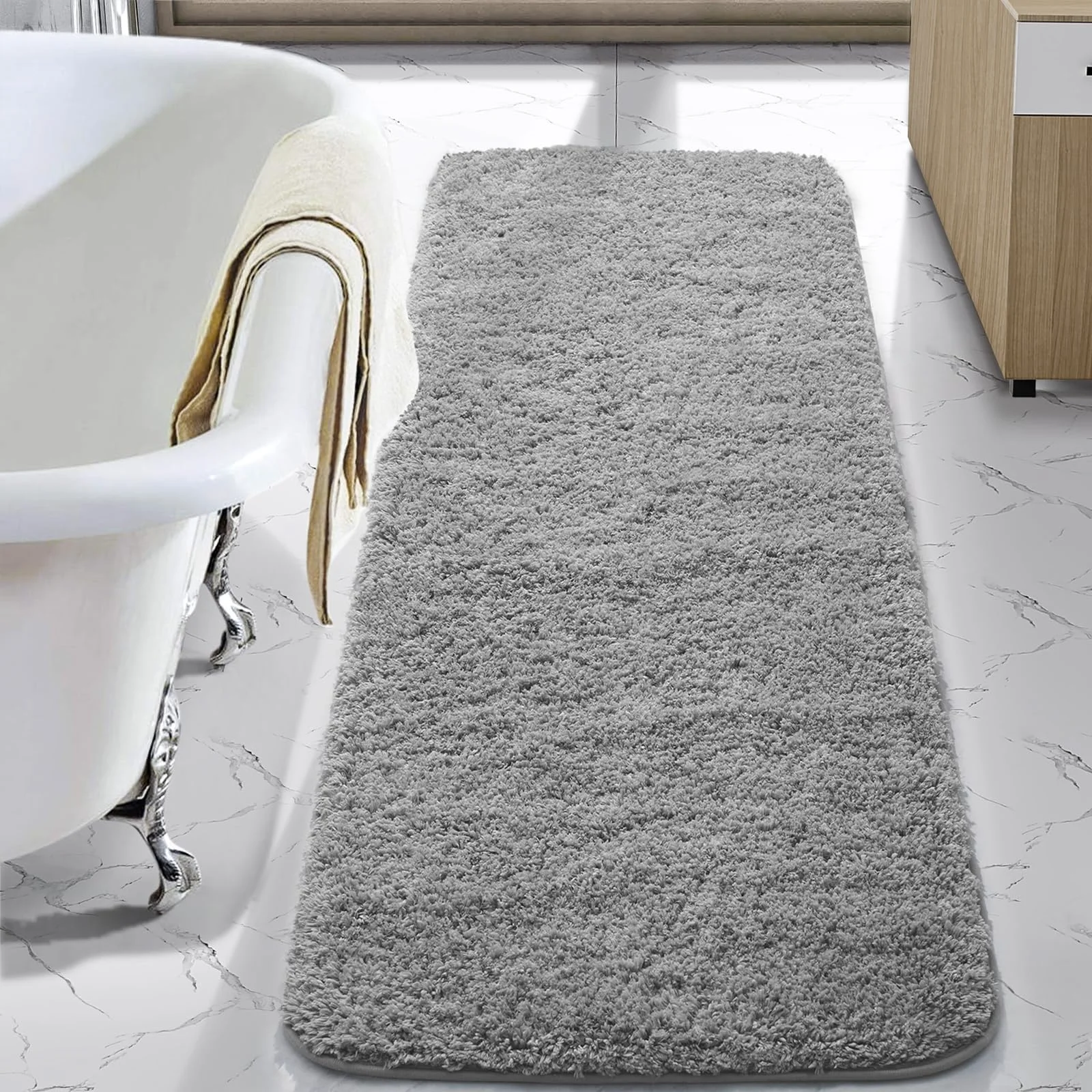
A bath mat lives on the floor of the most humid room in the house and is asked to do three things at once, none of which a rug is built for. It has to strip water from a bare foot in the moment after a shower, hold that moisture away from the tile, and then give it back to the air in time for the next person to do the same thing. The work is fast, wet and repeated, and a failure at any one of the three shows up as a sour smell, a slippery tile, or a mat that skids under weight.
A bathroom that goes without a mat for a year tells the same story in the floor itself. The same square foot of tile catches water every morning and evening. Grout lines darken where moisture sits, and a polished floor develops a thin film that never quite dries. The floor gets slicker over time, not from soap but from the slow buildup of mineral residue and body oils that a towel cannot reach. A mat is not decoration. It is the first line of defense for the floor and the feet that land on it.
What a Bath Mat Is Asked to Do
A rug in a living room cushions a foot and quiets a room. A bath mat works in the opposite direction. It needs to be thin enough that a door clears it, dense enough that water moves down into the pile rather than across the surface, and backed with a material that grips wet tile without sliding. The absorbency has to be immediate. A mat that takes three or four seconds to pull water off a foot leaves a wet footprint on the floor and a damp mat that stays wet longer than it should.
Water that sits on top of the pile is water that a bare foot spreads around. That is why a deep, plush surface, the kind that feels soft in a showroom, often works against a mat in a bathroom. Loose fibers hold water at the surface where it can be tracked onto the tile. A dense, short pile puts thousands of fiber ends against the skin and draws moisture down fast. The foot feels dry in a step or two, and the water is already on its way to the backing.
The third job, releasing moisture back to the air, happens after the shower is over. A mat that cannot dry between uses becomes a damp reservoir. Over days, that reservoir feeds mold and bacteria. The bathroom that has no window or fan is the hard case, and the mat in that bathroom has to work harder than any other textile in the house. The right pile and the right backing make drying possible. The wrong ones make it almost impossible.
How Chenille Pile Takes Water off a Foot
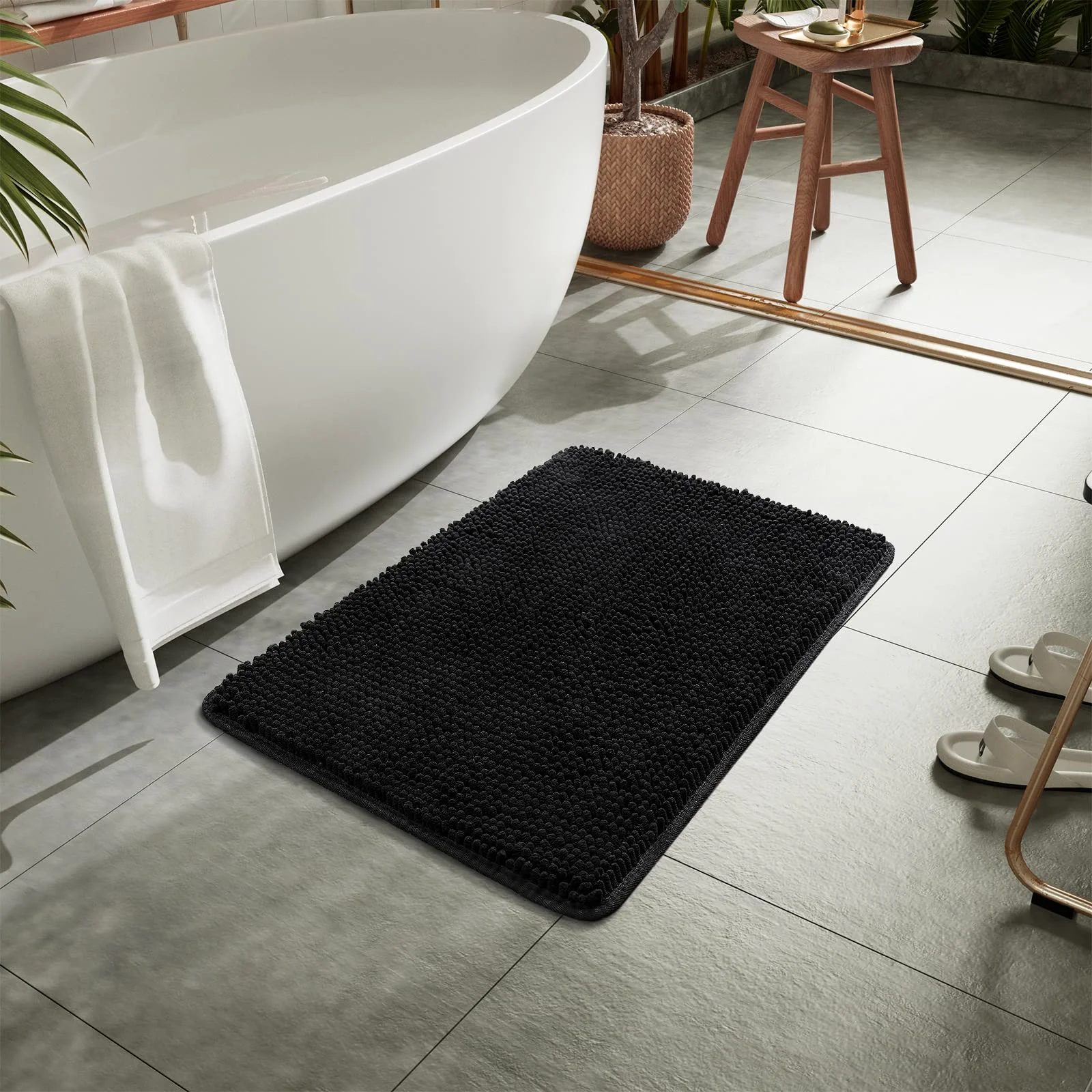
Chenille pile is built from thousands of small, compact tufts that stand upright on a backing. Each tuft is a bundle of microfiber strands, and the spaces between the tufts are what do the work. When a wet foot presses down, the tufts part just enough to let water travel between them, and capillary action pulls the moisture downward. On a well-made chenille mat, water leaves the surface in one to two seconds.
That speed matters because a foot does not stay still. A person steps out of the shower, plants one foot, shifts weight, and steps away. If the mat absorbs slowly, the foot carries water to the tile. A dense chenille pile catches the water at the first point of contact and sends it down to the backing before the second step. The surface feels dry almost instantly, not because the water vanished but because it moved.
This is where chenille parts ways with a plush velvet surface. Velvet pile is soft and even, but the fibers lie close together and trap water near the top. A foot on velvet meets a wet, cool surface that takes longer to feel dry. Chenille, with its tufted structure, gives water a clear path to the base of the mat. The pile height on our chenille bath mats is kept short for exactly this reason. More height would mean more softness, but it would also mean more water sitting where a foot can feel it.
A quick look at our chenille bath mats shows the range of sizes and colors, but the absorbency is the same across all of them. The tuft count is high enough that the mat can take a full step of water and be ready for the next person within an hour or two if the air is moving. That short drying window is what keeps a bathroom floor dry all morning.
Microfiber and Chenille, and Which Bathroom Suits Which
Microfiber and chenille are close relatives. Chenille is a way of constructing pile. Microfiber is the material. A chenille bath mat made from microfiber yarns combines the best of both: the water-channeling structure of tufted chenille and the absorbency of split microfiber strands. But the two are not interchangeable, and a bathroom that suits one may not suit the other.
A pure microfiber mat without the tufted chenille construction tends to have a flat, velvety surface. It feels smooth underfoot and dries quickly because the pile is thin. In a bathroom that is well ventilated and used by one or two people, a microfiber mat does the job well. It is light, easy to wash, and folds small. The trade-off is that a flat microfiber surface does not pull water away as aggressively as chenille tufts. A foot may feel damp for a second longer, and on a chilly tile floor that difference is noticeable.
Chenille, with its tufted structure, is the better choice for a bathroom that sees heavy use or has poor airflow. The tufts create channels that move water down fast, and the mat holds more water before it feels wet on top. In a family bathroom where three or four showers happen back to back in the morning, chenille keeps the floor drier than a flat microfiber mat can. The surface stays comfortable under bare feet, and the mat does not need to be hung up between every single shower.
The table below lines up the main pile types against the jobs a bath mat has to do.
| Pile type | Water off a foot | Drying speed | Underfoot feel | Machine washing |
|---|---|---|---|---|
| Chenille (microfiber tufted) | 1, 2 seconds | Moderate, quick if hung | Firm, dry, lightly textured | Yes, tumble dry low |
| Flat microfiber | 2, 3 seconds | Fast | Smooth, cool, thin | Yes, air or low heat |
| Cotton (terry loop) | 3, 5 seconds | Slow | Soft, warm, plush | Yes, can shrink, air dry best |
| Memory foam | Variable, often slow | Very slow | Cushioned, spongy | Not always, check the label |
Cotton terry mats feel soft and absorb eventually, but the loops hold water at the surface and dry slowly. In a humid bathroom, a cotton mat stays damp long enough to sour. Memory foam mats put a cushioned layer between the foot and the tile, but the foam itself does not dry quickly, and many cannot go in the wash. For a bathroom that needs to be dry and clean day after day, chenille and microfiber are the practical choices.
The Backing: Why It Matters for Safety and Durability
The pile does the absorbing. The backing keeps the mat in place and determines how well it survives the wash. On a LOCHAS bath mat, the backing is a layer of TPR rubber bonded across the whole underside. Bonded means the rubber is fused to the base of the mat, not glued in strips or printed in dots. A full bond gives the mat a uniform grip on tile, and it prevents water from pooling between the backing and the floor.
A backing that is applied in strips or dots behaves differently on a wet tile. The gaps between the grip points let water seep underneath, and the mat can slide when weight shifts. A full-coverage TPR backing holds the mat steady because the entire underside makes contact with the floor. The rubber itself is flexible, so it stays soft underfoot and does not crack when the mat is rolled or folded for the wash.
The backing is also the part of the mat that takes the most abuse in the laundry. Hot water and high heat break down rubber over time. A mat washed on a hot cycle and dried on high heat may come out with a backing that is stiff, cracked, or peeling at the edges. The bond between the rubber and the pile can fail if the mat is overheated. That is why every care label says the same thing: machine wash cold or warm, and tumble dry on low or hang dry. The pile can take the water. The backing cannot take the heat.
A bath mat that stays in place on a wet floor does more than prevent a slip. It keeps the floor underneath dry, which means the tile does not develop that slick film over time. The mat takes the water, the backing seals it off from the tile, and the whole assembly stays where it was put. That is the safety equation in a bathroom.
Drying a Bath Mat in a Bathroom That Never Sees Sunlight
A mat that stays wet between showers is a mat that will sour.
The honest part of owning a bath mat is that it has to dry. One that never fully dries develops a musty smell that washing resets rather than prevents, and that smell is bacteria working on moisture trapped in the pile and the backing. With a window and a good fan, drying happens on its own. Without them, the mat needs help.
The first thing that helps is hanging the mat over the edge of the tub or shower rod with the backing facing the air. The pile side dries faster than the backing, so exposing the rubber side to moving air cuts the drying time in half. Running the exhaust fan for twenty or thirty minutes after a shower pulls humid air out of the room and pulls drier air across the mat. The combination of hanging and airflow can dry a chenille mat in under an hour in a small bathroom.
Stacking a wet mat traps the moisture. Folded over itself, bunched on the floor, or under a wet towel, it dries only where air touches it, the inner layers stay damp, and in a day or two it starts to smell.
The Environmental Protection Agency advises fixing water problems as soon as possible and drying items completely. The agency warns that absorbent or porous materials such as carpet may have to be thrown away once they become moldy, because mold grows into the crevices of porous material and can be hard or impossible to remove. A bath mat is a porous material. Once mold takes hold in the pile or the backing, washing may not reach it. The drying step is not optional. It is the difference between a mat that lasts years and one that ends up in the trash after a season.
A windowless bathroom often needs two mats in rotation. One dries while the other is on the floor, and each gets a full drying cycle.
Washing: Heat Is the Enemy of Rubber
Machine washing a bath mat is simple, and the details decide whether it comes out as good as it went in. Cold or warm water, a gentle cycle and a mild detergent are all it needs. Hot water cleans harder but weakens the bond between the rubber backing and the pile, and over time the backing stiffens and cracks. The dryer does the same at high heat. Tumble on low, or hang the mat where the air moves.
Hot water and high heat are the quickest way to destroy a rubber-backed mat.
How often a mat needs washing depends on the household. A single person who showers once a day and hangs the mat afterwards can wash it every two weeks: it gets wet once, dries fully, and picks up little body soil.
A family of four, with back-to-back showers and a bath at night, is a different case. The mat stays damp for hours, picks up soap residue and skin cells, and rarely gets a full dry cycle, so it wants washing every five to seven days. A spare in rotation makes that easy: one on the floor, one in the wash, neither wet for days.
A household that bathes a dog in the tub adds hair, dander and the occasional muddy paw, and that mat wants washing after every bath. A second mat kept for dog baths is the simplest answer.
Deep pile follows the same principle on a longer timescale, and ten years of pile takes that view: low heat, gentle cycles and air drying keep fibers and backing intact.
Footing, Falls, and the Limits of a Rubber Backing
A bath mat with a full TPR backing grips a clean, dry tile floor reliably. The rubber compound is designed to hold fast when weight shifts, and the mat stays flat underfoot. That grip is one part of bathroom safety, but it is not the whole story.
The Centers for Disease Control and Prevention reports that about 300,000 hip fracture hospitalizations a year in the United States follow older adult falls. The CDC lists making the home safer among the main preventive steps. Their recommendations include installing grab bars inside and outside the tub and next to the toilet, getting rid of things you could trip over, adding railings on both sides of stairs, and putting more light in the home. A bath mat is part of that picture, but only part.
A bath mat is only as steady as the floor beneath it.
A rubber backing cannot grip a floor that is dusty, soapy, or freshly polished. The tiny particles of dust or polish act like ball bearings between the rubber and the tile. The mat may hold still under a light step and then slide when full weight comes down. The fix is simple: the floor under the mat needs to be clean and dry before the mat goes down. A quick wipe with a dry cloth before placing the mat is enough.
The mat itself should lie flat with no curled edges, because a corner flipped up by the dryer catches a toe. Smoothing it down while it is still slightly damp settles the edges. Size matters here too: too small leaves wet tile exposed, too large bunches against the tub and makes a ridge.
A doorway onto a hard floor wants something else again. Door mats carry a shorter pile and a grippier backing for grit and outdoor water, where a bath mat is built for bare feet and shower water.
Sizing a Bathroom Fixture by Fixture
A bath mat that fits the space does its job without becoming a trip hazard. The right size depends on the fixture it sits in front of and the clearance around it. Our bath mat sizes run from 17 by 24 inches up to 24 by 84 inches, plus contour pieces at 20 by 20 and 25 by 20 inches. That range covers every spot in a bathroom where a wet foot lands.
In front of a tub
A standard tub is 60 inches long. A mat that runs most of that length catches water along the whole step-out zone. A 24 by 60 inch mat gives full coverage. In a smaller bathroom, a 20 by 32 inch mat placed where the bather steps out is enough. The key is that the mat extends at least a foot beyond the point where the foot hits the floor.
Along a double vanity
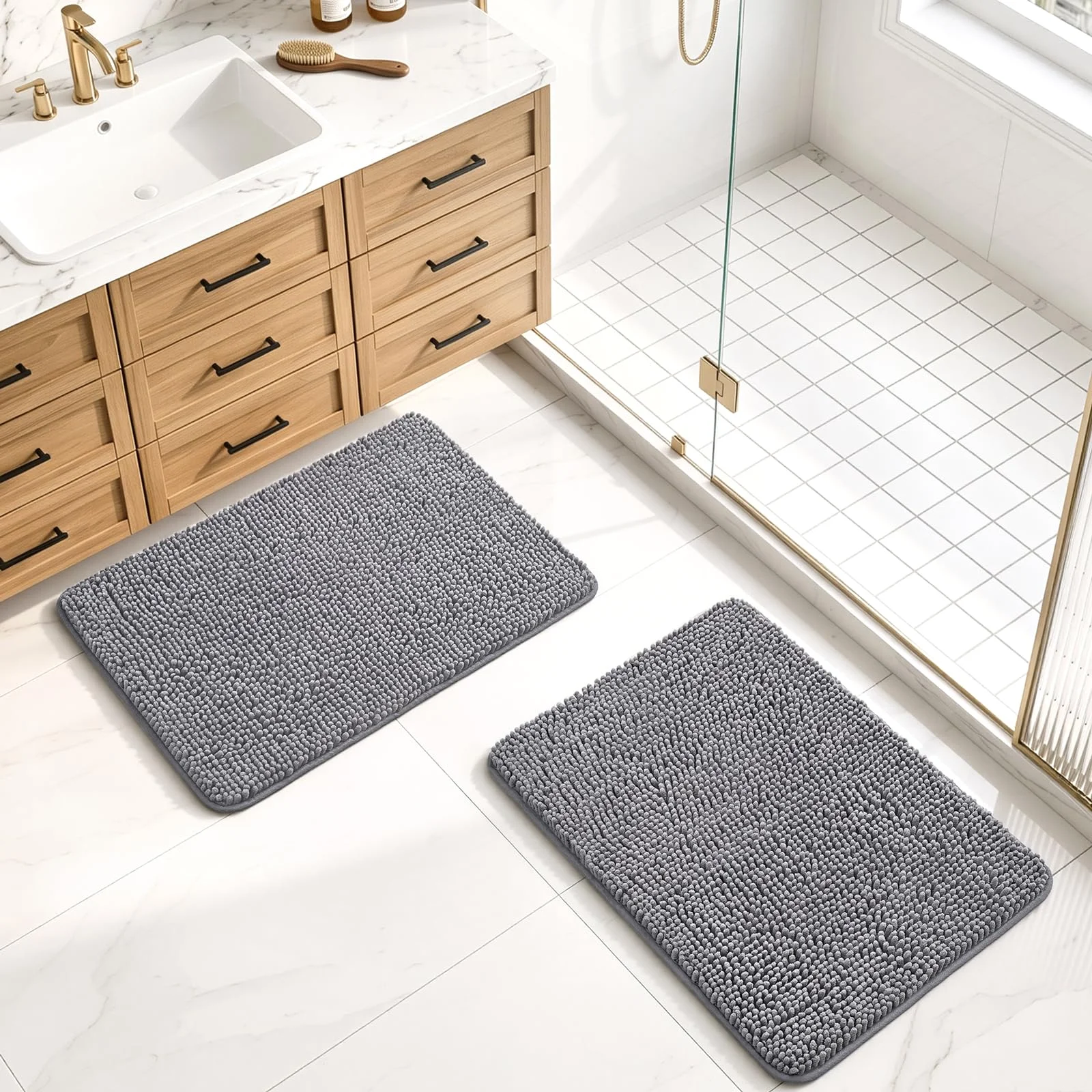
A double vanity can be five or six feet wide. Two people stand side by side, and water drips from hands and faces as well as feet. A long runner, such as a 24 by 60 or 24 by 72 inch mat, spans the width and gives each person a dry place to stand. Long bath runners are made for exactly this layout.
At a shower door
A shower stall door is narrower than a tub, often 24 to 36 inches wide. A 20 by 32 inch mat or a 24 by 40 inch mat placed directly outside the door catches the first step. If the shower is in a corner, a square contour piece at 20 by 20 inches fits neatly without overlapping the toilet or vanity.
Around a toilet base
The floor around a toilet gets splashes and bare feet. A contour rug shaped to fit around the toilet base, such as our 20 by 20 or 25 by 20 inch toilet contour rugs, hugs the base without bunching. The shape keeps the mat out of the walkway and puts pile right where the feet land.
In a narrow bathroom
A bathroom that is only five feet wide may not have room for a full-length runner. A 17 by 24 inch mat in front of the tub and a second small mat at the vanity give coverage without crowding the floor. Two small mats are better than one large one that gets kicked out of place.
The table below matches common bathroom fixtures to the mat sizes we make.
| Bathroom fixture | Recommended mat size | Notes |
|---|---|---|
| Standard tub (60 in) | 24 × 60 in | Full step-out coverage |
| Small tub or shower stall | 20 × 32 in or 24 × 40 in | Fits narrow openings |
| Double vanity (60, 72 in) | 24 × 60 in or 24 × 72 in | One runner across both stations |
| Toilet base | 20 × 20 in or 25 × 20 in contour | Wraps the base without bulk |
| Narrow bathroom (under 6 ft wide) | 17 × 24 in (one or two) | Keeps walkway clear |
A good fit means the mat does not overlap a floor vent, does not block a door swing, and does not curl up against a wall. Measuring the clear floor space in front of each fixture before choosing a size avoids the most common sizing mistake. For a broader look at fitting rugs to rooms, the guide on sizing a rug room by room walks through the same logic for every space in the house.
One Color Across a Bathroom or Three: The Case for Sets
A bathroom with one mat in one color is a quiet room. The eye lands on a single block of color against the tile and the rest of the room recedes, which is what a small bathroom wants. A deep navy or dark gray mat in front of a white tub gives the floor a clear focal point. Put a green mat at the tub, a blue one at the vanity and a beige one at the toilet, and the floor becomes a patchwork that pulls the eye three ways and makes the room feel smaller.
Bath rug sets solve this at the point of purchase. A set includes a contour piece for the toilet and a larger mat for the tub or vanity, both in the same color. The color match is exact, and the pile height is consistent. The set gives the bathroom a cohesive look without the work of matching pieces from different dye lots. A third mat, a runner for the vanity, can be added in the same color from the same line.
A set also washes together, which means it fades together and the bathroom keeps one tone. Mats bought one at a time over months drift apart under bathroom light.
The LOCHAS bath mats range spans 51 colors, so finding a single color that works across all the fixtures is a matter of choosing once and sticking with it. The color that works in a bright, windowed bathroom may not work in a windowless one. Light colors show water spots less. Dark colors hide wear longer. The choice is personal, but the rule of one color across the room holds.
The Luminous Line: A Low Glow for Dark Bathrooms
The Luminous bath mat line is built on the same chenille pile as the rest of the range, with one addition. The pile takes in light during the day and emits a soft glow at the edges in a dark bathroom. The glow is not a light source. It does not illuminate the room or replace a night light. What it does is give the mat a faint outline that is visible to dark-adapted eyes.
That outline serves a simple purpose. Someone walking into a dark bathroom can see where the mat begins and ends, which is enough to guide a bare foot to the dry surface. There is no switch, no battery and no wire: the glow charges from whatever light the room gets during the day and fades over the night. It is not a safety device in the way a grab bar is, and it does not prevent a fall.
The pile performance is the same as the standard chenille mat. Water off a foot in one to two seconds, TPR backing, machine washable. The glow is a feature added to a mat that already does its main job well. For a bathroom that stays dark for long stretches, a Luminous mat is a small, quiet upgrade that makes the floor a little more legible in the dark.
A bathroom mat is a simple thing, but the demands on it are not simple. It has to absorb fast, dry fast, stay put, and survive the wash. The right pile, the right backing, and the right size make all three jobs possible. When those things line up, the bathroom floor stays dry, the mat stays fresh, and the feet that land on it find something steady and warm.
Public guidance on flammability, falls and damp is quoted here as the agencies publish it. None of it is medical, legal or professional advice, and where an agency says something different from a sentence above, the agency is right.
